A Case for Print Magazines.
Societal attitudes toward digital media have changed significantly over the last decade. I distinctly remember thinking to myself in the 2010s: "Who would PAY for magazines these days?" And yet, here I am in 2026, having just bought a year's subscription to Game Informer, eagerly anticipating my first issue.
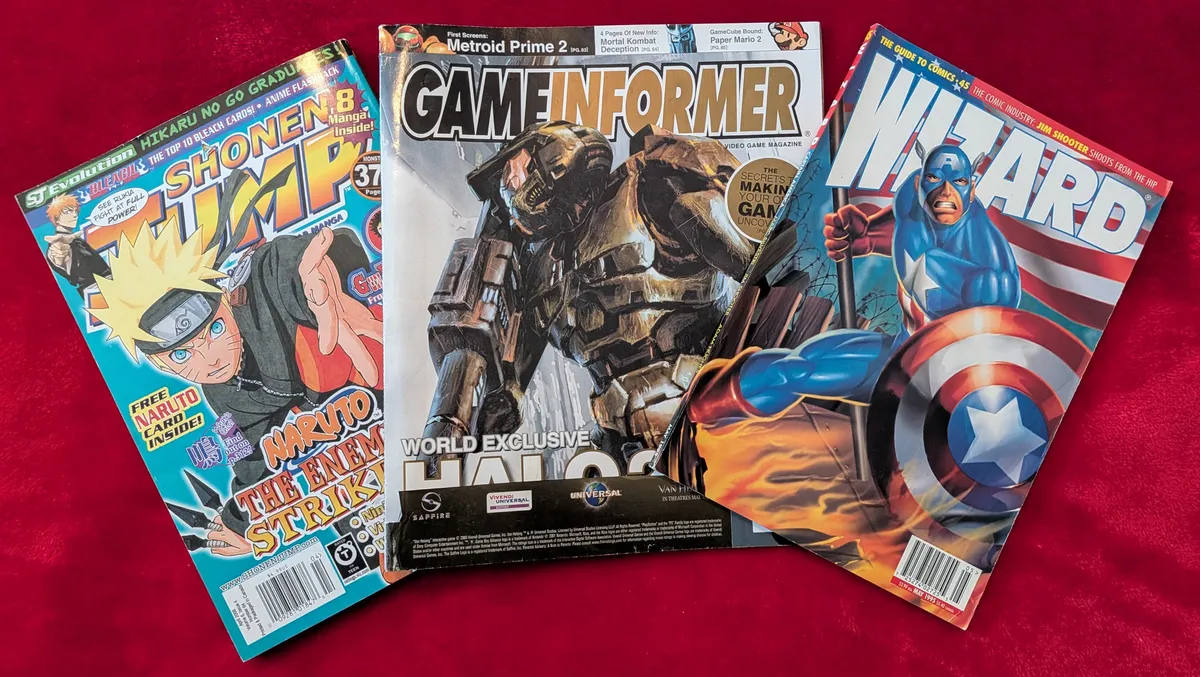
More and more, people are tired of being perpetually connected. Many are starting to feel that digital media has become a form of dystopian algorithmic enslavement. The movement to regain control of our thoughts and set boundaries with technology is admirable. However, this sentiment often devolves into self congratulatory rambling or pretentious diatribes. This post isn't intended to be another soap box speech. I simply want to highlight how physical magazines still have value.
- The obvious: Print magazines circumvent the problems associated with digital media.
A physical magazine is deliberately created to offer a certain experience. It has a definite ending, and the content is organized to logically guide you there. Physical magazines don't have algorithms. They can't monopolize your time or try to recommend a new story, what you see is what you get. It's refreshing to not wade through an endless landfill of AI generated recommendations. Small selections of curated stories eliminate doom scrolling and choice paralysis.
- Paywalls lead to a better product.
For paywalled publications, the reader pays for the privilege. Inherently, this lends itself to higher quality. Failure to deliver at an expected standard results in fewer subscribers, which hurts the bottom line. Unlike the ad driven business used by most online media, the profit model is structured such that simply grabbing the reader's attention with low quality slop isn't sufficient. The incentive is not to keep your eyes glued to the magazine in perpetuity, the incentive is to create a thoughtful experience.
- Print magazines are sensory.
For certain media formats, the convenience of digital delivery is so significant that the physical vs. digital debate is worth discussion. Music is a great example. I believe streaming has been an overall net benefit for music discovery and curation.
This doesn't apply to magazines. Of course you can make an argument for storage, magazines take up space after all. But for purely consuming content, digital magazines are completely sub optimal. Scrolling around the page with your fingers on a touch screen to follow the progression of the articles is fatiguing, and the connection between the text and visuals becomes fragmented. A screen can simply never replicate the immersion print magazines are designed to induce.
- Pertinent today, a time capsule tomorrow.
Concluding with my favorite thing about magazines: They become a window into the past. Magazines are so great because they provide a holistic interpretation of past events as they happened. Last month, I found myself captivated by an article about "Black Mesa" (The Half Life video game remake), in a 2013 Game Informer magazine. I didn't pay any attention to it at the time, but with the knowledge that Black Mesa would be fraught with development challenges and finally release in 2020 to acclaim and adoration, reading the article made for a uniquely intriguing experience.
Thank you for your time, I hope you consider reading about your hobby in a print magazine in the future.
- 33rd President Harry S. Truman